
A rugged tablet for logistics is a purpose-engineered edge computing platform designed to sustain deterministic uptime, secure data integrity, and real-time operational continuity across the most volatile nodes of global supply chains—including forklift cabs, refrigerated trailers, outdoor distribution hubs, and mining haul trucks. Unlike consumer or semi-rugged alternatives, it integrates MIL-STD-810H environmental validation, IP66+ ingress protection, wide-temperature battery and display systems, and vehicle-grade power architecture to eliminate hardware-induced blind spots in inventory reconciliation, temperature compliance, proof-of-delivery, and ELD-mandated hours-of-service logging—directly supporting multi-year fleet deployment cycles with <0.5% annual failure rates and up to 60% lower integration debt versus heterogeneous device rollouts.
Supply Chain Resilience Demands Hardware That Does Not Fail—Not Just Once, But Consistently
Supply chain resilience is no longer measured solely in buffer stock or dual-sourcing strategy—it is increasingly defined by the reliability of the physical data collection layer at the operational edge. When port congestion, labor shortages, or climate-driven infrastructure stress converge, the weakest point of failure is rarely algorithmic latency or ERP configuration drift; it is the endpoint device that fails to scan a pallet barcode in a humid container yard, drops GNSS lock during last-mile navigation in an urban canyon, or freezes mid-transaction due to thermal throttling inside a -25°C frozen-food trailer. Such failures propagate upstream: a single malfunctioning unit on a Class 8 tractor-trailer can delay electronic proof-of-delivery (ePOD) submission, trigger regulatory scrutiny under FDA 21 CFR Part 11 or EU GDP Annex 15, and compromise cold-chain audit trails—potentially invalidating entire shipments. Commercial tablets, optimized for user experience rather than operational durability, typically exhibit 18–24 months of functional field life before battery capacity degrades below 70%, touchscreen laminates delaminate under vibration, or display contrast collapses in sub-zero conditions. In contrast, purpose-built rugged tablets undergo full-cycle environmental validation—including MIL-STD-810H Methods 514.8 (vibration), 516.8 (shock), 502.8 (temperature shock), and 507.3 (humidity)—to ensure predictable performance across 5+ years of continuous 24/7 operation. This predictability translates directly into quantifiable operational advantages: mean time to repair (MTTR) reductions of 40–65% through standardized spare-part ecosystems; spares inventory optimization via consolidated BOMs and long-lifecycle component sourcing; and avoidance of unplanned integration rework when legacy devices fail mid-deployment cycle—especially critical for enterprises standardizing on WMS platforms like Manhattan SCALE or TMS stacks such as Blue Yonder.
The total cost of ownership (TCO) calculus has shifted decisively toward lifecycle governance over upfront capex. Replacing 200 tablets every 18 months incurs more than hardware procurement costs—it demands labor for image reconfiguration, driver retraining, MDM policy re-enrollment, API credential rotation, and regression testing against telematics middleware. A standardized rugged tablet architecture, validated for Microsoft Intune and VMware Workspace ONE management, enables zero-touch provisioning, unified firmware version control, and seamless compatibility with enterprise-grade WMS, TMS, and ELD-compliant telematics stacks. Procurement leaders evaluating five-year TCO now prioritize vendors offering formalized lifecycle programs—including minimum five-year BIOS/firmware update commitments, Windows IoT Enterprise long-term servicing channel (LTSC) support, and IEC 62443-2-1-aligned obsolescence notification protocols—because architectural consistency reduces integration debt by up to 60% compared to ad-hoc, spec-driven device selection.
Fleet Deployment Is Not About Mobility Alone—It’s About Mounting Integrity, Power Stability, and Environmental Continuity
Fleet-deployed rugged tablets operate within a physics-defined environment where mobility is secondary to mechanical, electrical, and thermal stability. Consider the operational profile of a forklift-mounted unit: sustained 5–20 Hz vibration during mast elevation and ramp traversal; intermittent 9–36 V DC power delivery as the engine cycles between idle and load; ambient temperature swings from -29°C in freezer docks to +63°C on asphalt under direct sun; and persistent exposure to hydraulic fluid mist, dust, and condensation during environmental transitions. Standard mounting solutions—such as suction-cup or generic RAM brackets—lack the structural rigidity to maintain alignment under these forces, leading to touchscreen misregistration, camera focus drift, or complete mechanical detachment. Likewise, consumer-grade power architectures assume stable 5 V USB input; they fail catastrophically under the voltage transients common during diesel engine cranking or alternator load spikes. A rugged tablet must therefore integrate engineered solutions at the hardware level—not as add-ons, but as intrinsic design features.
Mounting Flexibility and Mechanical Interface Design
Enterprise logistics managers must evaluate not just whether a device can be mounted, but whether its chassis supports production-grade integration across diverse mobile assets—from AGVs and automated stacker cranes to mining haul trucks and refrigerated reefers. Key requirements include DIN-rail adapters for industrial control cabinets, OEM-specific bracket interfaces for OEM forklift dashboards, and magnetic or bolted vehicle docking systems that preserve full peripheral access (USB-C, RJ45, CAN bus) without requiring disassembly. The absence of such interfaces forces reliance on third-party mounting kits, which introduce additional failure points, void warranties, and complicate field service.
Power Architecture and Electrical Resilience
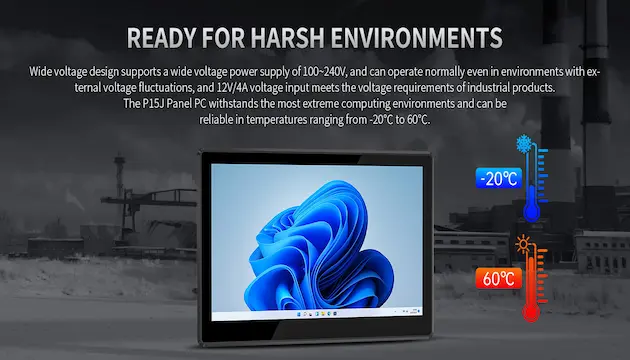
Vehicle power systems are inherently unstable: alternator ripple, cold-cranking voltage sag (<9 V), and transient overvoltage events (>36 V) are routine—not anomalies. A rugged tablet must accept 9–36 V DC input with integrated overvoltage/undervoltage protection, reverse-polarity safeguarding, and wide-temperature battery management—eliminating the need for external DC-DC converters that add cost, weight, and potential failure modes. Units with passive cooling and wide-voltage tolerance avoid thermal throttling and brownout-induced resets during high-load operations like simultaneous GNSS/Wi-Fi 6E scanning and barcode decoding.
Environmental Handoff and Operational Continuity
Transitioning between environments—such as moving from a -20°C frozen dock into a +40°C staging yard—introduces rapid thermal gradients that cause internal condensation, LCD response lag, and capacitive touch controller calibration failure. Industrial-grade units mitigate this through hermetically sealed enclosures, desiccant-integrated gaskets, and firmware-level thermal compensation algorithms that maintain touchscreen responsiveness and display contrast without manual recalibration delays.
Telematics Interoperability and Edge Integration
True fleet readiness extends beyond connectivity to protocol-native integration. CAN bus, RS232, and GPIO interfaces must be available natively—not via dongles or external gateways—to enable direct communication with lift-height sensors, weigh scales, engine ECUs, and telematics gateways. This eliminates integration risk, reduces latency in real-time telemetry pipelines, and ensures deterministic behavior during ELD-compliant duty-status transitions.
Technical Specifications Must Align with Workflow Physics—Not Marketing Benchmarks
Selecting a rugged tablet for logistics requires shifting from spec-sheet comparisons to workflow physics analysis—the measurable, repeatable environmental and operational variables that govern how the device performs in situ. Processor benchmarks, while relevant for computational workloads, are secondary to thermal stability under sustained scanning loads; display resolution matters less than sunlight legibility under angled viewing conditions; and battery capacity is meaningless without hot-swappable architecture for uninterrupted 14-hour shifts. Barcode scanning in a high-volume parcel sortation center, for example, depends not on peak CPU clock speed but on sustained illumination stability, low-latency sensor triggering, and firmware-level noise rejection—particularly under fluorescent flicker, low-light pallet shadows, or reflective corrugated surfaces. Similarly, glove-touch responsiveness is not a function of raw capacitive sensitivity alone, but of signal-processing firmware that distinguishes intentional pressure from ambient vibration—a capability critical when verifying manifests while riding a forklift over uneven concrete.
Sunlight readability, often reduced to a “nit rating” in marketing collateral, reflects optical stack engineering: high-brightness LED backlights must be paired with anti-reflective, oleophobic coatings and laminated touch layers to prevent parallax shift and fingerprint smudging. A 1000-nit display without these elements remains illegible under direct sun; conversely, an 800-nit panel with superior optical bonding and surface treatment may outperform it in real-world verification tasks. Thermal management is equally contextual: active cooling introduces moving parts prone to failure in dusty environments, whereas passive heat dissipation—using aluminum chassis conduction and vapor chamber technology—ensures silent, maintenance-free operation across thousands of hours in forklift or trailer cab deployments.

| Feature | Standard Market Approach | Rugged Industrial Solution | Why It Matters for Logistics Fleet Deployment |
|---|---|---|---|
| Display Brightness | 400–500 nits, glossy surface | 800–1000 nits, anti-glare laminated LCD | Enables legibility in direct sun without shade hoods—reducing driver distraction during outdoor dock verification. |
| Battery Life | 8–10 hours nominal, non-replaceable | Dual hot-swappable batteries, 12+ hours per pack | Eliminates downtime during 14-hour shifts; avoids reliance on unreliable vehicle USB ports. |
| Wireless Connectivity | Wi-Fi 5, Bluetooth 4.2, optional LTE | Wi-Fi 6E/7, Bluetooth 5.4, integrated LTE/GNSS, optional 5G | Ensures stable handoff between warehouse Wi-Fi, yard mesh networks, and cellular fallback—no dropped manifest uploads. |
| Environmental Rating | IP52 (splash resistant), no MIL-STD | IP66 + MIL-STD-810H, -29°C to +63°C operational range | Guarantees function inside frozen food trailers, dusty quarry sites, and humid port terminals—without thermal recalibration delays. |
| Input Interfaces | USB-C only, no legacy support | USB-C + USB-A + RJ45 + CAN bus + GPIO | Allows direct integration with weigh scales, RFID readers, and fleet telematics without external hubs or protocol converters. |
Enterprise Procurement Requires Validation Beyond Certification—It Needs Lifecycle Governance
Procurement teams evaluating a rugged tablet for logistics must treat vendor selection as infrastructure governance—not commodity acquisition. Certifications such as IP66 and MIL-STD-810H provide necessary baseline assurance, but they do not validate interoperability with Windows IoT Enterprise LTSC builds, long-term driver support for specialized peripherals (e.g., Zebra SE4710 scanners), or supply chain transparency for component-level replacements like GNSS modules or touch controllers. Leading vendors now embed formal lifecycle governance into their offerings—including documented five-year firmware update windows aligned with NIST SP 800-161 cybersecurity guidelines, configurable OS lockdown modes for kiosk-style WMS terminals, and granular obsolescence notification protocols compliant with IEC 62443-2-1. This level of governance becomes operationally decisive at scale: a global 3PL managing cross-border fleets must ensure identical firmware stacks, driver signing certificates, and regional radio certifications (e.g., EU CE vs. US FCC LTE bands) ship pre-validated—avoiding fragmented QA testing across regional IT teams and minimizing time-to-deployment in new operating jurisdictions.
Platform consolidation further amplifies strategic value. Enterprises deploying both mobile and fixed-edge infrastructure benefit significantly when their rugged tablet and industrial pc portfolios share common thermal management architecture, mounting kinematics, peripheral ecosystems, and remote diagnostics tooling. Such convergence reduces spares complexity, unifies telemetry ingestion pipelines, and accelerates root-cause analysis across distributed assets—from forklift-mounted tablets capturing lift-cycle data to fixed-mount IPCs running vision-guided pallet inspection. Moreover, vendors offering certified integrations with major MES and WMS providers—documented API payloads, standardized error-handling behavior, and joint escalation SLAs—enable faster incident resolution during mission-critical production incidents. As supply chain digitization matures, the market is shifting from isolated hardware procurement toward orchestrated infrastructure partnerships—where vendors like b2b rugged devices deliver not just hardened endpoints, but end-to-end telemetry aggregation platforms integrating GNSS, IMU, and CAN bus data into edge AI inference pipelines for predictive maintenance alerts, route deviation detection, and autonomous dispatch optimization. In this context, the rugged tablet ceases to be a terminal—and evolves into a deterministic, data-native node in the supply chain’s operational nervous system.
How does temperature variation impact rugged tablet performance in cold-chain logistics?
Extreme cold affects battery chemistry, LCD response time, and touch controller calibration. Consumer tablets often shut down below 0°C due to lithium-ion voltage sag; industrial-grade units use wide-temperature batteries (e.g., LiFePO₄) and active thermal management to maintain functionality down to -29°C—ensuring uninterrupted temperature logging and electronic proof-of-delivery in pharmaceutical or frozen-food distribution.
What makes a rugged tablet suitable for forklift-mounted deployment versus handheld use?
Forklift-mounting introduces sustained vibration (5–20 Hz), intermittent power, and mechanical shock during mast lifting or ramp traversal. Suitable units feature reinforced chassis anchoring points, wide-voltage DC input (9–36 V), passive cooling, and vibration-dampening internal mounts—unlike handheld-focused models optimized for ergonomics rather than vehicular integration.
How do rugged tablets reduce integration debt in enterprise logistics software stacks?
By supporting standardized Windows IoT Enterprise images, certified WMS/TMS drivers, and MDM-managed policy enforcement (e.g., disabling camera or microphone in compliance-sensitive zones), rugged tablets eliminate per-device configuration scripting and enable zero-touch provisioning—cutting deployment time per unit from hours to minutes and reducing annual integration maintenance effort by up to 45%.