
Modern warehouse operations are undergoing a structural transformation—not merely in scale or speed, but in architectural intelligence. As supply chains tighten and labor constraints intensify, the traditional model of centralized data processing and batch-oriented task execution is proving inadequate. The emergence of real-time inventory reconciliation, predictive picking path optimization, and dynamic slotting algorithms demands low-latency decision loops that cannot be sustained by cloud-dependent architectures alone. This reality has elevated the role of the rugged tablet for warehouse from a passive scanning terminal to an active edge node—capable of local inference, protocol translation, sensor fusion, and bidirectional orchestration with warehouse management systems (WMS), material handling equipment (MHE) controllers, and industrial PLCs. Yet most procurement decisions still treat rugged mobility as a peripheral hardware upgrade, overlooking its function as a distributed computing endpoint within a larger system integration framework. When edge compute capabilities—such as AI-accelerated barcode decoding, on-device OCR for damaged labels, or real-time vibration anomaly detection—are constrained by thermal throttling, memory bandwidth bottlenecks, or non-deterministic OS scheduling, the entire architecture degrades: latency spikes, integration debt accumulates, and operational continuity erodes under environmental stress.
Architectural Implications of Edge-First Warehouse Mobility
The shift toward edge-native workflows requires rethinking how mobile devices interface with legacy infrastructure—not as isolated endpoints, but as interoperable components within a deterministic, time-aware control plane. A conventional warehouse may deploy dozens of disparate systems—RFID gateways, forklift-mounted PLCs, automated guided vehicle (AGV) fleet managers, temperature loggers in cold storage zones, and WMS instances hosted on-premises or in hybrid clouds. In this context, the rugged tablet for warehouse serves not just as a human interface, but as a lightweight edge orchestrator: translating Modbus TCP to MQTT, buffering sensor telemetry during intermittent LTE coverage, or pre-processing camera feeds before forwarding only relevant metadata upstream. This functional expansion necessitates hardware-level design choices rarely visible in spec sheets—such as deterministic interrupt latency (<100 µs), PCIe Gen4 support for co-located vision accelerators, and real-time OS compatibility (e.g., Windows 11 IoT Enterprise with Hyper-V isolation). Without such foundations, even high-end processors like the 12th Gen Intel® Core™ i5 in the SCORPION 10 Ultra or the AMD Ryzen™ AI 5 340 in the Getac G140 cannot guarantee consistent inference timing—a critical failure mode when validating pallet integrity via on-device computer vision during high-speed put-away cycles. Crucially, these requirements are not abstract engineering ideals; they directly impact mean time between failures (MTBF) in high-vibration environments, where micro-fractures in solder joints caused by mechanical resonance can silently degrade USB enumeration reliability over time—introducing intermittent integration faults that evade standard QA testing but manifest as unexplained transaction drops during peak throughput windows.
Why Compute Determinism Matters More Than Raw Clock Speed
Unlike consumer-grade tablets optimized for burst performance, industrial edge nodes require sustained throughput across thermally variable conditions—from sub-zero freezer aisles to sun-baked dock doors. Standard thermal throttling profiles cause CPU frequency collapse after 90 seconds of continuous barcode streaming or video analytics, introducing unpredictable jitter into time-sensitive WMS handshakes. Worse, many “rugged” devices run full Windows without kernel-level tuning, allowing background services (Windows Update, Defender scans, telemetry) to preempt real-time tasks. In contrast, purpose-built edge tablets integrate hardware watchdog timers, BIOS-level power capping, and dedicated AI cores (e.g., AMD XDNA or Intel NPU) that operate independently of the main CPU—ensuring barcode decode pipelines remain uninterrupted while the OS manages UI rendering or network stack housekeeping. This separation is foundational to system integration resilience: it transforms the device from a fragile client into a predictable, stateful participant in distributed control loops. For example, in a Tier-1 distribution center deploying autonomous mobile robots (AMRs), a non-deterministic tablet used for manual intervention cannot reliably issue synchronized stop commands to adjacent AMRs if its GNSS timestamping drifts beyond ±5ms—risking collision scenarios that violate IEC 61508 SIL-2 safety requirements. Determinism isn’t about theoretical benchmarks—it’s about enforceable timing guarantees embedded at silicon level.

Integration Debt and the Hidden Cost of Non-Standard Interfaces
One of the most underestimated operational liabilities in warehouse digitization is integration debt—the cumulative engineering effort required to bridge proprietary protocols, inconsistent data models, and undocumented firmware behaviors across heterogeneous device fleets. When a logistics provider deploys mixed-vendor rugged tablets—some with USB-C-only I/O, others with legacy RS-232 serial ports, and still others relying exclusively on Bluetooth HID emulation—the WMS integration layer must accommodate divergent drivers, polling intervals, and error recovery mechanisms. This complexity multiplies exponentially when attempting to federate data from tablets into enterprise service buses (ESBs) or event-driven architectures (e.g., Apache Kafka). For instance, the Urovo RT40S’s 15-meter long-range scanning capability becomes operationally irrelevant if its decoded payloads lack standardized GS1-128 framing or require custom parsing logic per firmware revision. True interoperability begins at the silicon level: consistent driver stacks, vendor-agnostic API abstraction layers (such as Microsoft’s Windows Driver Framework for Industrial Devices), and hardware-enforced secure boot ensure that every tablet behaves as a predictable node—not a configuration liability. Integration debt compounds over time: each custom adapter increases mean time to repair (MTTR), extends patch deployment cycles, and impedes compliance auditing—especially under ISO/IEC 62443-4-2, which mandates verifiable traceability of all software components in industrial control systems.
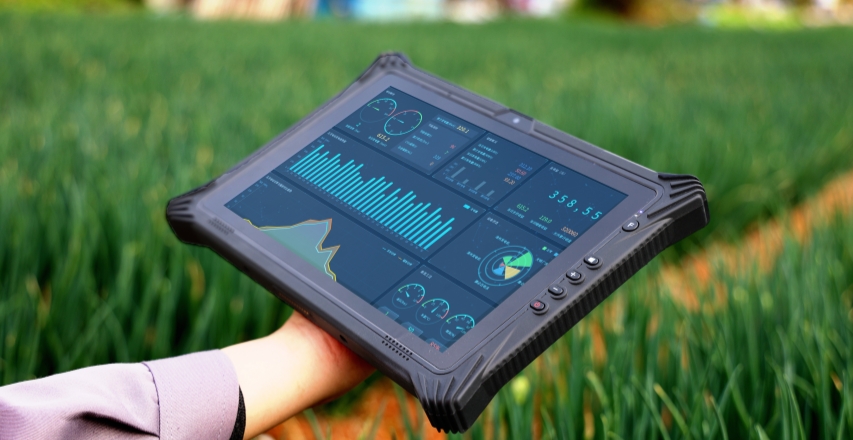
Standardized Edge Abstraction Layers Reduce Lifecycle Overhead
Enterprises deploying large-scale mobile edge infrastructure benefit significantly from unified abstraction frameworks. These include standardized communication stacks (e.g., OPC UA over TSN for deterministic time-synchronized messaging), containerized edge applications (deployed via Kubernetes Edge distributions like K3s), and hardware-rooted trust anchors for zero-touch provisioning. Devices like the Getac G140—featuring dual removable batteries, Wi-Fi 7, and Gigabit LAN—support such architectures not just through raw connectivity, but via deterministic packet scheduling and IEEE 1588 PTP timestamping support. Similarly, the SCORPION 10 Ultra’s MIL-STD-810H certification ensures mechanical stability under sustained vibration, preventing micro-fractures in solder joints that would otherwise induce intermittent USB enumeration failures—another silent source of integration drift. Investment in such physical-layer reliability directly amortizes integration engineering costs over device lifecycles exceeding five years, a key differentiator versus consumer-derived “semi-rugged” alternatives. From a total cost of ownership (TCO) perspective, modularity enables phased upgrades—for example, swapping a legacy 1D imager for a vision-based AI scanner without replacing the entire device—preserving integration investments and simplifying compliance recertification under manufacturing automation standards.

Technical Benchmarking: From Marketing Claims to Integration-Ready Capabilities
| Feature | Consumer/Tablet-Class Approach | Industrial-Grade Rugged Tablet for Warehouse |
|---|---|---|
| Thermal Management | Passive aluminum chassis; no active cooling; thermal throttling begins at 65°C ambient | Dual-fan active cooling + vapor chamber; validated operation from −29°C to +63°C without performance loss |
| Power Delivery | Single fixed-voltage input (5V/9V/15V); incompatible with forklift battery fluctuations (12–36 VDC) | Wide-input DC-DC converter (9–36 VDC); isolated power rail prevents brownout-induced firmware corruption during lift-truck engine cranking |
| Connectivity Determinism | Wi-Fi 6 with best-effort QoS; no support for Time-Sensitive Networking (TSN) or hardware timestamping | Wi-Fi 6E/Wi-Fi 7 with 802.11mc RTT, TSN-aware NICs, and IEEE 1588 PTP hardware clock synchronization |
| OS & Firmware Control | Unlocked Windows updates; no signed driver enforcement; firmware update rollback unsupported | Locked-down Windows 11 IoT Enterprise; Secure Boot + Measured Boot; atomic firmware updates with verified rollback capability |
| I/O Architecture | USB-C only; no field-replaceable modules; limited GPIO expansion | Modular I/O bay supporting hot-swappable serial, CAN FD, or M12 Ethernet; programmable GPIO with interrupt-on-change triggering |
These distinctions are not incremental—they define whether a device can function as a trusted component within an orchestrated edge architecture or remains a fragile, high-maintenance endpoint requiring bespoke middleware. For instance, wide-input power delivery is not simply about compatibility with forklift batteries: it eliminates voltage sag-induced crashes during engine cranking events—common in multi-shift facilities where 30% of unplanned downtime originates from power instability in mobile workstations. Likewise, IEEE 1588 PTP hardware clock synchronization enables sub-millisecond coordination between tablet-based motion capture and AGV fleet controllers—making closed-loop robotic coordination feasible without costly external timing infrastructure.
Strategic Procurement: Prioritizing Architecture Alignment Over Feature Lists
For IT directors and automation architects, evaluating a rugged tablet for warehouse must begin with integration mapping—not benchmark scores. Does the device expose standardized APIs for barcode decode status, battery health telemetry, or GNSS fix quality? Can its embedded LTE module be configured to maintain persistent VPN tunnels using certificate-based mutual TLS—without OS-level intervention? Is its display controller capable of hardware-accelerated overlay rendering for AR-assisted picking, independent of GPU load? These questions reveal whether the device supports scalable deployment or introduces hidden governance overhead. Leading manufacturers now offer development toolkits aligned with industry reference architectures—for example, b2b rugged devices platform integrates with Azure IoT Edge and AWS Greengrass v2 out-of-the-box, reducing time-to-production for edge AI pipelines by up to 60%. Likewise, Emdoor’s rugged tablet portfolio emphasizes deterministic I/O timing and open driver interfaces, enabling seamless integration with legacy industrial pc-based control cabinets deployed across Tier-1 distribution centers. Such architectural alignment lowers total cost of ownership not through lower unit price, but through reduced integration labor, extended mean time between failures (MTBF), and simplified compliance auditing across ISO/IEC 62443 and IEC 61508 domains. Procurement teams should evaluate vendors against three measurable criteria:
- Integration Velocity: Time required to onboard new device models into existing CI/CD pipelines for edge application deployment
- Failure Traceability: Ability to correlate hardware-level telemetry (e.g., thermal sensor logs, power rail voltage variance) with application-level errors in centralized observability platforms
- Certification Portability: Reuse of security attestations (e.g., FIPS 140-3, IEC 62443-4-2) across device generations without re-auditing core firmware components
Actionable FAQs for Enterprise Procurement Teams
How does a rugged tablet for warehouse contribute to edge computing architecture beyond basic scanning?
A rugged tablet for warehouse functions as a distributed edge node when equipped with deterministic compute, standardized industrial protocols (e.g., OPC UA, MQTT-SN), and hardware-enforced security. It enables local preprocessing of sensor data, real-time validation against business rules (e.g., lot expiration checks), and synchronized command issuance to nearby MHE—reducing reliance on round-trip cloud latency and minimizing single points of failure in mission-critical workflows.
What certifications indicate true readiness for system integration—not just physical durability?
Beyond IP66 and MIL-STD-810H, look for IEEE 1588 PTP hardware clock support, IEC 62443-4-2 certification for secure development lifecycle, and conformance to IEC 61000-6-4 (EMC emissions) and IEC 61000-6-2 (EMC immunity). These validate deterministic behavior in electrically noisy environments—critical when co-located with variable-frequency drives or RF-intensive RFID portals.
Why should warehouse operators prioritize modularity over all-in-one form factors?
Modular rugged tablets allow field-replaceable components (scanning engines, batteries, I/O modules), decoupling hardware lifecycle from software evolution. This enables phased upgrades—for example, swapping a legacy 1D imager for a vision-based AI scanner without replacing the entire device—preserving integration investments and simplifying compliance recertification under manufacturing automation standards.
The convergence of rugged mobility and edge computing is no longer aspirational—it is operational necessity. As warehouses evolve into adaptive, self-optimizing ecosystems, the rugged tablet for warehouse must be architected not as a terminal, but as a node: physically resilient, computationally deterministic, and integratively transparent. This demands moving beyond environmental ratings and screen brightness into the deeper strata of real-time OS fidelity, protocol standardization, and hardware-rooted security. When selected with system integration and edge architecture as primary criteria—not secondary features—these devices become catalysts for sustainable automation maturity, reducing integration debt, extending asset lifespans, and enabling next-generation use cases like closed-loop robotic coordination and autonomous inventory reconciliation. For organizations seeking verifiable scalability, the path forward lies not in isolated hardware specs, but in holistic architectural alignment—starting with the edge device held in the operator’s hand.